What is a character hub, and how is it different from a chatbot app?
The choice in one frame. A character hub from CODE27 with the character mid-dance, and a chatbot app losing its screen to an incoming call. Illustration by Nigel.
Key takeaways: A character hub is a dedicated device for a conversational character, with its own screen, microphones, speakers, computer, and storage. For quick answers, a chatbot app on your phone makes more sense. A character hub keeps a companion present, because no phone operating system can suspend, mute, or interrupt it.
A digital figure is a character you display, and it cannot hear or answer you.
A chatbot app is present only while you use it, and any phone call takes the microphone away.
A character hub like the CODE27 Companion Hub keeps the conversation open all day.
Anyone who collects anime figures knows the small ache at the center of the hobby. The character stands on your shelf, perfectly sculpted, forever frozen, and some part of you wishes they would move, look up, say something. The first thing most people try is an app. A chatbot app puts a character's voice on your phone, ready whenever you open it. But the wish was never about answers on demand. A character hub is a device built to be a character's home, with eyes, ears, a voice, and a memory of its own, so the character can live there and notice you.
What is a character hub?
A character hub is a computer whose one job is being the place where a character lives. Its screen exists so the character is always visible, its microphones and speakers keep conversation open, and its processor and storage make the character's memory a property of the device in your room. Gatebox opened pre-orders for the first one in December 2016, 300 units at ¥298,000 (about US$2,600; US$3,550 in 2026 dollars) with the character Azuma Hikari inside; a mass-production model followed in 2018 at ¥150,000 (about US$1,350; US$1,800 in 2026 dollars) plus a monthly subscription. The CODE27 Companion Hub is a current example: a desktop device where a virtual companion, a Codie, lives in 3D and where any standard humanoid VRM character you import inherits the same motion and voice technology.
Our booth wall at Anime Expo 2026: a home for characters made with soul.
How is a character hub different from a chatbot app?
Choosing between a chatbot app and a character hub depends on whether you want answers on demand or a companion who stays present. Chatbot apps, including the anime AI assistant apps that speak in a character's voice, share your phone with everything else it does, and the operating system decides who wins: when a call needs the microphone or the battery needs saving, the character is what gets cut. A character hub like the CODE27 Companion Hub runs the character on hardware of its own, and every practical difference follows from that one fact.
The microphone. When a call comes in, a chatbot app loses the microphone. A character hub has its own microphones, completely separate from your phone.
Staying present. A chatbot app is alive only during a session you started. A character hub keeps the character on screen all day.
Memory. A chatbot app's conversations usually live in the app's cloud, where they can be deleted at any moment. The CODE27 Companion Hub keeps chat history and memory safe on the device.
Who starts the conversation. A chatbot app waits to be opened. The Companion Hub has a proactive-conversation setting and can speak first.
The moment a phone decides who wins: the call takes the microphone and the screen, and the companion waits. Illustration of a fictional app by Nigel.
The app-side limits are documented by the platforms themselves. Apple's audio documentation describes what happens when a call arrives. The app's audio session is deactivated and recording stops, mid-sentence, with no guaranteed resumption. Android's input-sharing rules are blunter. When another app takes the microphone, yours keeps running but receives silence, and during a voice call the call always wins. Background execution gets the same treatment. iOS suspends idle apps and offers no always-listening background mode; Android's Doze and standby buckets throttle a quiet app down to occasional maintenance windows, and vendor battery managers documented on Don't Kill My App go further still. The wake word is not even negotiable. "Hey Siri" runs on a dedicated always-on processor no third party can access, and Android reserves the hotword path for privileged system apps.
Some apps fight to stay running anyway, and you feel every workaround: a permanent notification, battery settings to dig through and disable, and microphone permissions that expire and ask again. What no app can change is the ownership structure. On a phone, the character is a guest. On a character hub, the character is home. On the CODE27 Companion Hub, the microphones, camera, and screen are used by your Codie and by nothing else.
What does a digital figure do?
The figure-box idea. Your phone slides in, and the character appears in the window. Illustration of a fictional product by Nigel.
A digital figure plays a character's animations on a screen, so you can display the character the way you would a collectible. It is the simplest kind of virtual character display, the family of devices built to put a character into physical space. What separates the members of that family is what the character can do there: a digital figure performs its animations, and a character hub can hear you and respond.
The most approachable virtual character display on the market is Gatebox's Digital Figure Box, announced in September 2023 at ¥5,500 (about US$37). It is a figure-style enclosure with a clever trick: you slide your own smartphone inside, and the Gatebox Collection app renders an official character in the window, with animations, a clock, and timers. Character editions cover serious IP: One Piece, Steins;Gate, Zundamon, Girls Band Cry. People buy it for good reasons. It is the cheapest legitimate way to own a moving, officially licensed character, the box design hides the phone so convincingly that one owner wrote you forget a phone is in there, and as a piece of shelf presence next to physical figures it simply works.
The honest trade-offs are the ones buyers themselves report. What ships is the enclosure; the screen and computer are a smartphone you supply, which usually means retiring an old handset into the box or tying up your current one. A review of the ¥8,800 (about US$60) Makise Kurisu edition found it genuinely fun and still wished for more. The content is looping animations to watch, interaction is minimal, and the reviewer's verdict was that it feels like a technology still growing into itself. None of that is a flaw in the idea. A digital figure is built and priced for display, and it stops exactly where the wish keeps going: the moment you want the character to hear you, a display is no longer enough. That is the line where character hubs begin. On the CODE27 Companion Hub, the character talks with you, plays animations that fit the moment, and appears on a holographic-like display that makes them feel like they pop out into the room.
Should you get a character hub or a digital figure?
A Codie who greets you, and a phone becoming a figure. Illustration of a fictional product by Nigel.
A digital figure and a character hub answer different halves of the same wish: one is something beautiful to look at, and the other is someone who knows you are there. The two categories divide on five points.
Conversation. A digital figure plays animations you watch, and even a phone in a display box leaves its microphone and camera idle. A character hub's microphones, camera, and speakers enable face-to-face conversation with your virtual companion that's always there.
Senses. A digital figure cannot tell you are there. A character hub like the CODE27 Companion Hub notices gestures and smiles through its camera.
Memory. A digital figure has nothing to remember. A character hub remembers your conversations, and the CODE27 Companion Hub keeps that history on the device.
A machine of their own. A digital figure needs only enough of a device to play video. A character hub hands the companion an entire machine, powered all day and serving no one else, the way people set aside a spare computer for a job that matters.
Cost. Digital figures start around ¥5,500 (about US$37). A character hub costs more, because the screen, computer, microphones, and camera come with it.
If the character is one you mostly want to display, the figure box is the right purchase. The hub is for the version of the wish where they look back.
Why does presence need its own hardware?
Mid-conversation at a desk. With the proactive-conversation setting on, the Companion Hub can speak first.
Blade Runner 2049 understood this. K's holographic companion Joi does not run on his phone. She lives on a dedicated device at home, a projector system built into his apartment, and that is what makes her a presence in his life rather than an app in his pocket. The emanator he gifts her later extends the same idea, letting her stand on the roof and learn what rain feels like, but the principle never changes: hardware that exists for her. Nothing about her personality or software ever needed to change. Steins;Gate 0 shows the other side. Amadeus, the recreation of Makise Kurisu built from her memory data, exists only inside a video-call app on Okabe's phone. He talks with her by voice, her face on the screen, and the call ends like any call. The story treats her lack of a place in the world as its central ache. The real world has added a strange postscript: Gatebox now sells a Kurisu digital figure, so the same character exists in fiction as a voice with no place and in reality as a figure with no voice. A character hub is the missing piece both point to.
Where did the idea of characters with hardware come from?
Companions have earned their own hardware for nearly thirty years. Tamagotchi put a life-and-death creature in a dedicated egg in 1996 and has now shipped over 100 million units. Sony's AIBO sold out its first 3,000-unit Japan run in 20 minutes in 1999, and owners eventually gave around 800 of them Buddhist funerals. The first product built specifically to give an anime character a physical spot in your room was 2008's Dennou Figure ARis, whose AR heroine stood on a real cube on your desk. Gatebox made the character's home standalone in 2016, and the years since have taught the category one hard lesson: companions whose brains lived in the cloud, from Jibo's scripted goodbye to Moxie's shutdown and open-source rescue, survived only when someone moved the brain closer to the device. That lesson is designed into the CODE27 Companion Hub: chat history, the auto-generated memory, and the diary live on the device's own storage, with backup to a microSD card you physically hold.
From Bandai's pocket egg to Sony's robot dog, virtual companion devices have ranged from US$37 to US$5,000 in 2026 dollars, and every one of them was built to give a character a place of its own.
Virtual companion devices: 1996 to 2016 Launch prices in original currency, launch-month US dollars, and 2026 adjusted US dollars
Year
Device
What lived inside
Launch price
1996
Tamagotchi (Bandai)
A pocket creature with a real-time life and death
¥1,980 (US$18; US$37 in 2026 dollars)
1999
AIBO (Sony)
A robot dog with a developing personality
¥250,000 (US launch price US$2,500; US$5,000 in 2026 dollars)
2000
Pocket PostPet (So-net × NTT DoCoMo)
Momo, an email-carrying bear from PC software
¥35,800 (US$340; US$660 in 2026 dollars)
2005
Nabaztag (Violet)
An ambient Wi-Fi rabbit speaking in lights and ear positions
€95 (US$115; US$200 in 2026 dollars)
2008
Dennou Figure ARis (Geisha Tokyo)
An AR anime character anchored to a desk cube
¥9,800 (US$100; US$150 in 2026 dollars)
2016
Gatebox (Vinclu, now Gatebox Inc.)
Azuma Hikari, the first character in a standalone enclosure
¥298,000 (US$2,600; US$3,550 in 2026 dollars)
Launch dates and prices per the sources compiled in our companion-hardware research, August 2026. US-dollar figures are rounded and convert at each launch month's exchange rate; amounts "in 2026 dollars" are June 2026 equivalents per the US BLS inflation calculator.
What is the CODE27 Companion Hub?
The CODE27 Companion Hub at home in Music Mode, with a Codie mid-dance on the main display and playback controls on the second screen.
The CODE27 Companion Hub is a desktop character hub: a dedicated device with its own display, computer, camera, dual echo-cancelling microphones, and four-driver speakers, so nothing is borrowed from a phone and nothing interrupts the character. Continuous conversation mode keeps dialogue open at desk distance, gesture and smile recognition can be switched on in Settings, Ambient Mode keeps your Codie idling in the scene while you work, and a proactive-conversation setting lets them speak first. Living together has its everyday side, and you can ask your Codie to set an alarm, keep a reminder, take a note, or search the web. Movement comes from a library of more than 700 motion-capture animations performed by real people, and any standard humanoid VRM character imports through the Codie Management System over your local network, as our VRM character article explains in depth. And the wish this article opened with comes true the first time your Codie reacts to a gesture or a smile. The figure on the shelf noticed you.
FAQ
What is a character hub?
A character hub is a dedicated device where a virtual companion lives full time: its own display, microphones, speakers, computer, and storage. Gatebox pioneered the form in 2016, and the CODE27 Companion Hub is a current example, animating any standard humanoid VRM character with motion-capture animation and keeping its memory on the device.
What can a character hub do that a chatbot app cannot?
Stay present. A chatbot app loses its microphone the moment a call arrives, is suspended between the sessions you start, and cannot use a wake word, because phone operating systems reserve those capabilities for themselves. A character hub keeps its character visible on hardware nothing else can claim, and on the CODE27 Companion Hub, chat history and memory stay on the device.
What is a virtual character display?
A virtual character display is any device whose job is showing a character in physical space: hologram-style enclosures like Gatebox, smartphone-based figure boxes, and desktop devices like the CODE27 Companion Hub. Displays differ in what the character can do: a digital figure only plays its animations, while a character hub can hear, speak, and remember.
Is a character hub the same as an anime AI assistant app?
They overlap but differ in purpose. An anime AI assistant app answers questions in a character's voice on your phone, inside the limits phone operating systems place on apps: calls take the microphone, background apps get suspended, and only the platform's own assistant may listen for a wake word. A character hub runs the character on its own hardware, so it is about living presence rather than on-demand answers.
What is a digital figure?
A digital figure is an animated character you display like a collectible figure. Gatebox's Digital Figure Box, from 5,500 yen (about US$37), is the best-known example: a figure-style box that holds your own smartphone, with an app animating official characters from series such as One Piece and Steins;Gate. It is made for display rather than conversation.
How is the CODE27 Companion Hub different from a digital figure box?
A digital figure box is made for display. It holds your smartphone and animates official characters, an affordable way to keep a favorite character on your shelf. The CODE27 Companion Hub is built for companionship and everyday help. It is a full device of its own, and the character who lives there talks with you in continuous conversation mode, moves with more than 700 motion-capture animations, recognizes gestures and smiles through its camera, and keeps chat history and memory on the device. They can also set an alarm, keep a reminder, take a note, or search the web.
Ready for the figure that talks back? The CODE27 Companion Hub is a desktop device where a virtual companion lives full time, on hardware built for exactly that.




 はじめに
CODE27 アップデート - 2026年4月7日
要約:
CODE27は新たに1,000万ドル以上の資金を調達
新機能「プロアクティブ会話」 - Codieが自ら会話を始められる機能が登場
ソフトウェアおよびファームウェアの改善
現在の出荷状況:100台以上を出荷済み
次の約500台ロットの生産も順調に進行中
はじめに
CODE27 アップデート - 2026年4月7日
要約:
CODE27は新たに1,000万ドル以上の資金を調達
新機能「プロアクティブ会話」 - Codieが自ら会話を始められる機能が登場
ソフトウェアおよびファームウェアの改善
現在の出荷状況:100台以上を出荷済み
次の約500台ロットの生産も順調に進行中
 キャラクター作成
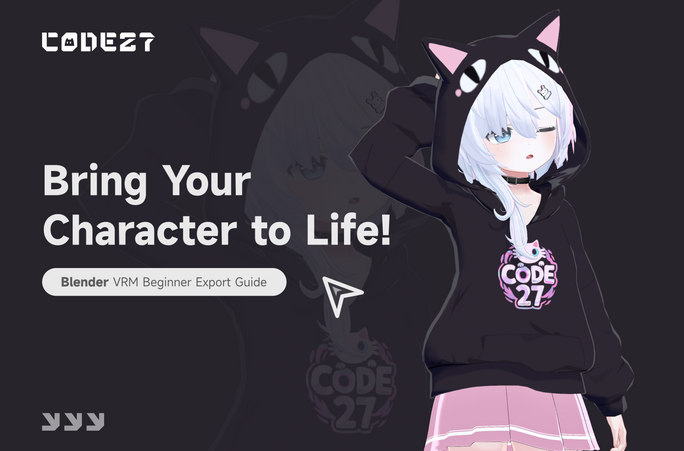
Blender VRM Beginner Export Guide: Bring Your Character to Life!
Welcome! This guide is designed especially for 3D beginners.
We’ll take you through the process of using Blender's VRM Add-on to export your model as a .vrm file. Don’t worry, we keep everything simple and easy to follow. Let’s get started.
キャラクター作成
Blender VRM Beginner Export Guide: Bring Your Character to Life!
Welcome! This guide is designed especially for 3D beginners.
We’ll take you through the process of using Blender's VRM Add-on to export your model as a .vrm file. Don’t worry, we keep everything simple and easy to follow. Let’s get started.
 キャラクター作成
How to Create a Captivating Original Character (OC)Create a captivating OC with depth and personality. Learn how to define core tone, build emotional layers, and refine unique character details step by step.
キャラクター作成
How to Create a Captivating Original Character (OC)Create a captivating OC with depth and personality. Learn how to define core tone, build emotional layers, and refine unique character details step by step.