



How to Choose an Anime Chat: Character Quality, Memory, Voice, and Privacy
A polished character card can make almost any anime chat look convincing. The real test begins a few messages later. Does the character still sound like the same person after the scene changes? Does a detail return naturally, or does the reply slide into generic assistant language? Before you invest time, data, or money, look past the library. Test the persona, find out what “memory” covers, and decide whether voice, visuals, privacy, price, and format fit your routine.
What Is Anime Chat?
Anime chat is interaction with an anime-style or anime-inspired AI character. Depending on the product, that may involve text, voice, generated images, animation, character creation, or a mix of these features. Behind one on-screen character may be separate parts: the visual avatar, written persona, conversation system, and memory layer.
It is not automatically a chatroom for anime fans. An otaku chat room generally connects people who want to discuss shows, games, characters, or fandom topics. Anime AI chat puts the virtual character at the center of the exchange. Knowing which kind of space you are entering makes feature lists, privacy policies, and pricing much easier to judge.
Start With Character Quality, Not Character Count
A huge library makes discovery fun, but says little about what happens after the introduction. Before paying or building a long roleplay, give the character a three-to-five-turn check.
Begin with something the profile should be able to hold onto: a goal, relationship, rule, or piece of lore. Then share one small preference of your own and watch for it in the next reply. Finally, move the conversation into a different setting or topic. The character should adapt without losing its established voice or rewriting the scene behind you.
Four signals are especially useful:
-
Persona consistency: The attitude and speaking style remain recognizable.
-
Lore continuity: Important details survive instead of being replaced by a new backstory.
-
Preference carryover: Your information returns where it is relevant, without being copied back mechanically.
-
Scene recovery: A topic change does not turn the character into a generic helper.
This is a filter, not a scientific benchmark. A few messages cannot prove long-term quality, but they can expose early drift. If an anime character chat loses its identity almost immediately, more voices, images, or unlockable characters will not fix the central problem.
When Does Anime Chat Need More Than a Chat Window?
A good conversation and a visible place solve different needs. Apps and browsers are portable, but you usually have to open or foreground them. Once the tab closes or the phone locks, the character is no longer in view.
For many people, that is exactly the right tradeoff. Portable, low-friction chat matters more than a permanent setup. Other users want the character visible while they work, draw, or play, even when they are not actively typing. At that point, the decision is no longer only about which service can hold a conversation. It is also about whether the character should have a dedicated place.
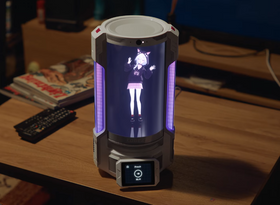
A dedicated 3D companion is one answer: standalone hardware that gives a customizable virtual character a fixed, visible place in the room. The CODE27 3D Companion Hub is one implementation of that idea, built around presence beyond a phone or browser. That shift can make location and visibility part of the experience, but it does not make the AI smarter, repair a weak persona, or guarantee better memory. Hardware also brings cost, setup, permissions, space, and network requirements that portable chat may avoid.
Beyond Character Consistency: Memory, Voice, and Visuals
Passing the first few turns is only the beginning. The longer experience depends on what the system carries forward and on how well its voice and visual presentation support the character.
Memory and Continuity
“Remembers you” is not a standardized promise. A system may follow the current exchange, save selected facts for future sessions, summarize older conversations, or let you inspect and correct stored details. Support for one of those functions does not guarantee the rest.
Look for concrete controls. You should be able to find out what persists, how long it remains available, and whether you can correct or remove it. Deleting a chat may not necessarily delete facts extracted from that chat, so check whether conversations and saved memories have separate controls. It is also worth knowing what happens when active memory reaches its limit. Those answers are more useful than an unexplained promise of “long-term” or “unlimited” memory.
Pay attention to correction, not just recall. If a saved detail is wrong, you need to know whether it can be changed before that error shapes later scenes. Otherwise, an early mistake can start masquerading as continuity.
Recall is only half of continuity. A system can remember your favorite game and still answer in a voice that no longer fits the character. Judge both whether information returns and whether the character uses it in a way that remains consistent with the persona and lore.
Voice, Visuals, and Roleplay
Voice, images, animation, and 3D presentation can change how a conversation feels. A well-matched voice makes timing and attitude easier to read. Expressions and movement can carry part of a roleplay scene without another block of narration, while visual tools can help an original character stay recognizable across different settings.
Each expressive layer may have its own limits. Voice and image generation can sit behind credits, subscriptions, queues, or content controls. Microphone and camera features introduce extra permissions. One product may give you detailed persona controls but a fixed visual model; another may provide an animated avatar while offering little control over the conversation system.
Presentation still needs to be judged separately from intelligence. More animation may make the encounter feel richer, but it does not demonstrate stronger reasoning, more reliable memory, or better character consistency.
Try the expressive features after the basic conversation check. That order makes it easier to tell whether a strong impression comes from the character itself or from polished presentation wrapped around an unstable persona.
Privacy, Access, and Cost Checks Before You Commit
Anime chat may involve personal conversations, recorded voice, uploaded images, custom models, and detailed character prompts. Before creating an account or paying, inspect the system behind the character.
-
Account and access: Check whether a browser trial is available, whether an app and verified account are required, and whether chats or character settings can be exported.
-
Storage and processing: Find out what stays on the device, what reaches the provider's servers, and whether third parties process any part of the interaction. Look for retention periods and model-improvement choices.
-
Permissions: Match microphone and camera access to the feature that needs it. Check whether either permission can be disabled without breaking unrelated functions.
-
Deletion and correction: Look for separate controls covering chats, generated media, uploaded files, and extracted memories, along with a clear account-deletion process.
-
Content and age settings: Review filters, reporting tools, age restrictions, and roleplay boundaries before building a character around the service.
-
Real cost: Free access may come with ads, message caps, energy systems, or paid voice and image credits. Hardware adds purchase cost, setup time, desk space, and possible accessories.
One privacy badge cannot answer all of these questions. A camera cover, for example, blocks the lens; it does not explain microphone behavior, cloud processing, chat storage, or third-party services. Read the current policy as a description of the whole system.
Anime Chat App, Browser, or Dedicated 3D Companion?
Choose the format around when and where you want to interact, not around which option appears most advanced.
|
Format |
Best for |
Main strength |
Main tradeoff |
|
Browser chat |
Quick access and low-commitment testing |
No dedicated hardware and easy switching between devices |
May depend on an account, an active tab, and web-specific limits |
|
Mobile app |
Portable voice, images, notifications, and frequent short sessions |
Convenient access away from the desk |
App permissions, feature gates, and smaller-screen presentation |
|
Animated avatar or screen pet |
A character that remains visible on a computer |
Lightweight expression without separate hardware |
Depends on the host computer and may use separate conversation software |
|
Dedicated 3D companion |
A fixed character presence in a room or desk setup |
Its own display and physical location |
Hardware cost, setup, space, permissions, and network dependence |
No format is inherently more intelligent. A browser may be ideal for occasional private text chat. An anime chat app makes more sense when you want voice and visual features wherever you go. Dedicated hardware becomes relevant only when location and continuous visibility are part of what you value.
Can You Use Your Own Anime Character?
Treat this as three questions rather than one: Can you define the persona, can the product display the visual model, and do you have permission to use the assets?
An original character (OC) may start as a persona prompt, commissioned artwork, a voice, or a 3D model. VRM is a platform-independent format for humanoid 3D characters and avatars. A valid VRM file is not a universal compatibility pass, however. Support can still vary with the rig, expressions, materials, body type, and the way each product implements the format.
Rights are a separate layer. Owning an image or downloading a model does not automatically grant permission to use its character design, artwork, voice, story, or 3D assets. Original, commissioned, or properly licensed materials are the clearest route. Check the product's technical requirements and the license attached to every asset.
Who Is a Dedicated 3D Companion Actually For?
Dedicated hardware is most relevant when visible presence is central. CODE27 works standalone without a PC connection, using a depth-effect display for character movement and expression. Current support focuses on compatible standard humanoid VRM models for original, commissioned, or properly licensed avatars.
Chat History, Memory, and Diary remain distinct. Memories are created automatically and can be reviewed, edited, or deleted. Current support describes around 10,000 conversation turns before older material is summarized. After enough meaningful interaction, a Codie can create a Diary entry.
Setup requires an account, Wi-Fi, sign-in, and updates; real-time AI uses network and cloud processing. CODE27 says history, memory summaries, and models are stored on the device. Its Privacy Policy separately describes cloud and third-party voice processing with distinct retention rules. On-device memory does not mean every input stays local.
The display creates depth rather than a free-space volumetric hologram, and VRM compatibility does not provide IP rights. Readers who prefer free, phone-first, hardware-free, or fully offline generative AI will probably be better served by an app or browser. CODE27 fits people who value visible desk presence enough to accept the cost, space, setup, and connectivity.
Anime Chat FAQs
Is anime chat the same as otaku chat?
Usually not. Anime chat commonly means interacting with an AI-driven anime-style character. Otaku chat may describe human fans talking in a community or chatroom. Because the terms can overlap, check how each product or community defines itself.
Is anime chat the same as an AI girlfriend?
No. Anime chat describes an interaction style and visual direction; an AI girlfriend describes a relationship frame. Some products overlap, but anime chat can focus on storytelling, original characters, creative roleplay, or non-romantic interaction.
Can anime chat work offline?
There is no safe category-wide answer. Offline support varies by feature. Check current documentation for conversation, voice, synchronization, updates, and locally stored functions instead of relying on one “offline” label.
Which Anime Chat Experience Fits You?
Choose a browser or app when portability, low setup, and experimentation matter most. Move toward richer visual formats when voice, expression, and roleplay materially change the experience. Dedicated hardware fits only when a stable, visible location is part of the goal.
Ready to give a custom character a place beyond the chat window? Explore the CODE27 3D Companion Hub and see whether a dedicated 3D presence fits your desk setup.
How to Choose an Anime Chat: Character Quality, Memory, Voice, and Privacy
A polished character card can make almost any anime chat look convincing. The real test begins a few messages later. Does the character still sound like the same person after the scene changes? Does a detail return naturally, or does the reply slide into generic assistant language? Before you invest time, data, or money, look past the library. Test the persona, find out what “memory” covers, and decide whether voice, visuals, privacy, price, and format fit your routine.
What Is Anime Chat?
Anime chat is interaction with an anime-style or anime-inspired AI character. Depending on the product, that may involve text, voice, generated images, animation, character creation, or a mix of these features. Behind one on-screen character may be separate parts: the visual avatar, written persona, conversation system, and memory layer.
It is not automatically a chatroom for anime fans. An otaku chat room generally connects people who want to discuss shows, games, characters, or fandom topics. Anime AI chat puts the virtual character at the center of the exchange. Knowing which kind of space you are entering makes feature lists, privacy policies, and pricing much easier to judge.
Start With Character Quality, Not Character Count
A huge library makes discovery fun, but says little about what happens after the introduction. Before paying or building a long roleplay, give the character a three-to-five-turn check.
Begin with something the profile should be able to hold onto: a goal, relationship, rule, or piece of lore. Then share one small preference of your own and watch for it in the next reply. Finally, move the conversation into a different setting or topic. The character should adapt without losing its established voice or rewriting the scene behind you.
Four signals are especially useful:
-
Persona consistency: The attitude and speaking style remain recognizable.
-
Lore continuity: Important details survive instead of being replaced by a new backstory.
-
Preference carryover: Your information returns where it is relevant, without being copied back mechanically.
-
Scene recovery: A topic change does not turn the character into a generic helper.
This is a filter, not a scientific benchmark. A few messages cannot prove long-term quality, but they can expose early drift. If an anime character chat loses its identity almost immediately, more voices, images, or unlockable characters will not fix the central problem.
When Does Anime Chat Need More Than a Chat Window?
A good conversation and a visible place solve different needs. Apps and browsers are portable, but you usually have to open or foreground them. Once the tab closes or the phone locks, the character is no longer in view.
For many people, that is exactly the right tradeoff. Portable, low-friction chat matters more than a permanent setup. Other users want the character visible while they work, draw, or play, even when they are not actively typing. At that point, the decision is no longer only about which service can hold a conversation. It is also about whether the character should have a dedicated place.
A dedicated 3D companion is one answer: standalone hardware that gives a customizable virtual character a fixed, visible place in the room. The CODE27 3D Companion Hub is one implementation of that idea, built around presence beyond a phone or browser. That shift can make location and visibility part of the experience, but it does not make the AI smarter, repair a weak persona, or guarantee better memory. Hardware also brings cost, setup, permissions, space, and network requirements that portable chat may avoid.
Beyond Character Consistency: Memory, Voice, and Visuals
Passing the first few turns is only the beginning. The longer experience depends on what the system carries forward and on how well its voice and visual presentation support the character.
Memory and Continuity
“Remembers you” is not a standardized promise. A system may follow the current exchange, save selected facts for future sessions, summarize older conversations, or let you inspect and correct stored details. Support for one of those functions does not guarantee the rest.
Look for concrete controls. You should be able to find out what persists, how long it remains available, and whether you can correct or remove it. Deleting a chat may not necessarily delete facts extracted from that chat, so check whether conversations and saved memories have separate controls. It is also worth knowing what happens when active memory reaches its limit. Those answers are more useful than an unexplained promise of “long-term” or “unlimited” memory.
Pay attention to correction, not just recall. If a saved detail is wrong, you need to know whether it can be changed before that error shapes later scenes. Otherwise, an early mistake can start masquerading as continuity.
Recall is only half of continuity. A system can remember your favorite game and still answer in a voice that no longer fits the character. Judge both whether information returns and whether the character uses it in a way that remains consistent with the persona and lore.
Voice, Visuals, and Roleplay
Voice, images, animation, and 3D presentation can change how a conversation feels. A well-matched voice makes timing and attitude easier to read. Expressions and movement can carry part of a roleplay scene without another block of narration, while visual tools can help an original character stay recognizable across different settings.
Each expressive layer may have its own limits. Voice and image generation can sit behind credits, subscriptions, queues, or content controls. Microphone and camera features introduce extra permissions. One product may give you detailed persona controls but a fixed visual model; another may provide an animated avatar while offering little control over the conversation system.
Presentation still needs to be judged separately from intelligence. More animation may make the encounter feel richer, but it does not demonstrate stronger reasoning, more reliable memory, or better character consistency.
Try the expressive features after the basic conversation check. That order makes it easier to tell whether a strong impression comes from the character itself or from polished presentation wrapped around an unstable persona.
Privacy, Access, and Cost Checks Before You Commit
Anime chat may involve personal conversations, recorded voice, uploaded images, custom models, and detailed character prompts. Before creating an account or paying, inspect the system behind the character.
-
Account and access: Check whether a browser trial is available, whether an app and verified account are required, and whether chats or character settings can be exported.
-
Storage and processing: Find out what stays on the device, what reaches the provider's servers, and whether third parties process any part of the interaction. Look for retention periods and model-improvement choices.
-
Permissions: Match microphone and camera access to the feature that needs it. Check whether either permission can be disabled without breaking unrelated functions.
-
Deletion and correction: Look for separate controls covering chats, generated media, uploaded files, and extracted memories, along with a clear account-deletion process.
-
Content and age settings: Review filters, reporting tools, age restrictions, and roleplay boundaries before building a character around the service.
-
Real cost: Free access may come with ads, message caps, energy systems, or paid voice and image credits. Hardware adds purchase cost, setup time, desk space, and possible accessories.
One privacy badge cannot answer all of these questions. A camera cover, for example, blocks the lens; it does not explain microphone behavior, cloud processing, chat storage, or third-party services. Read the current policy as a description of the whole system.
Anime Chat App, Browser, or Dedicated 3D Companion?
Choose the format around when and where you want to interact, not around which option appears most advanced.
|
Format |
Best for |
Main strength |
Main tradeoff |
|
Browser chat |
Quick access and low-commitment testing |
No dedicated hardware and easy switching between devices |
May depend on an account, an active tab, and web-specific limits |
|
Mobile app |
Portable voice, images, notifications, and frequent short sessions |
Convenient access away from the desk |
App permissions, feature gates, and smaller-screen presentation |
|
Animated avatar or screen pet |
A character that remains visible on a computer |
Lightweight expression without separate hardware |
Depends on the host computer and may use separate conversation software |
|
Dedicated 3D companion |
A fixed character presence in a room or desk setup |
Its own display and physical location |
Hardware cost, setup, space, permissions, and network dependence |
No format is inherently more intelligent. A browser may be ideal for occasional private text chat. An anime chat app makes more sense when you want voice and visual features wherever you go. Dedicated hardware becomes relevant only when location and continuous visibility are part of what you value.
Can You Use Your Own Anime Character?
Treat this as three questions rather than one: Can you define the persona, can the product display the visual model, and do you have permission to use the assets?
An original character (OC) may start as a persona prompt, commissioned artwork, a voice, or a 3D model. VRM is a platform-independent format for humanoid 3D characters and avatars. A valid VRM file is not a universal compatibility pass, however. Support can still vary with the rig, expressions, materials, body type, and the way each product implements the format.
Rights are a separate layer. Owning an image or downloading a model does not automatically grant permission to use its character design, artwork, voice, story, or 3D assets. Original, commissioned, or properly licensed materials are the clearest route. Check the product's technical requirements and the license attached to every asset.
Who Is a Dedicated 3D Companion Actually For?
Dedicated hardware is most relevant when visible presence is central. CODE27 works standalone without a PC connection, using a depth-effect display for character movement and expression. Current support focuses on compatible standard humanoid VRM models for original, commissioned, or properly licensed avatars.
Chat History, Memory, and Diary remain distinct. Memories are created automatically and can be reviewed, edited, or deleted. Current support describes around 10,000 conversation turns before older material is summarized. After enough meaningful interaction, a Codie can create a Diary entry.
Setup requires an account, Wi-Fi, sign-in, and updates; real-time AI uses network and cloud processing. CODE27 says history, memory summaries, and models are stored on the device. Its Privacy Policy separately describes cloud and third-party voice processing with distinct retention rules. On-device memory does not mean every input stays local.
The display creates depth rather than a free-space volumetric hologram, and VRM compatibility does not provide IP rights. Readers who prefer free, phone-first, hardware-free, or fully offline generative AI will probably be better served by an app or browser. CODE27 fits people who value visible desk presence enough to accept the cost, space, setup, and connectivity.
Anime Chat FAQs
Is anime chat the same as otaku chat?
Usually not. Anime chat commonly means interacting with an AI-driven anime-style character. Otaku chat may describe human fans talking in a community or chatroom. Because the terms can overlap, check how each product or community defines itself.
Is anime chat the same as an AI girlfriend?
No. Anime chat describes an interaction style and visual direction; an AI girlfriend describes a relationship frame. Some products overlap, but anime chat can focus on storytelling, original characters, creative roleplay, or non-romantic interaction.
Can anime chat work offline?
There is no safe category-wide answer. Offline support varies by feature. Check current documentation for conversation, voice, synchronization, updates, and locally stored functions instead of relying on one “offline” label.
Which Anime Chat Experience Fits You?
Choose a browser or app when portability, low setup, and experimentation matter most. Move toward richer visual formats when voice, expression, and roleplay materially change the experience. Dedicated hardware fits only when a stable, visible location is part of the goal.
Ready to give a custom character a place beyond the chat window? Explore the CODE27 3D Companion Hub and see whether a dedicated 3D presence fits your desk setup.
Recommended
What Matters After the First Conversation With an AI Girlfriend?
Search for an AI girlfriend and you quickly run into character galleries, “best” lists, and free-trial promises. They...
Desktop Waifu Guide: Screen Pet, AI Assistant, or Dedicated 3D Companion?
Sometimes you do not want another character app that disappears the moment you close a tab. You want the character to...